Researchers Develop Nanopore Platform for Time-Resolved Monitoring of Catecholamine Metabolism
Catecholamines, including dopamine, noradrenaline (also known as norepinephrine), and adrenaline (also known as epinephrine), are essential neurotransmitters and hormones that regulate neural and endocrine functions. Disruption of their biosynthesis is associated with a broad range of neurological, psychiatric, and metabolic disorders. However, conventional analytical methods often lack the temporal resolution and sensitivity required to dynamically track multiple metabolites throughout an entire enzymatic pathway. Existing nanopore sensing approaches have also largely focused on individual analytes, making real-time monitoring of a complete metabolic cascade particularly challenging.
Prof. WU Hai-Chen from the Institute of Chemistry, Chinese Academy of Sciences, and Prof. LIU Lei from Xihua University developed a nanopore-based single-molecule platform for time-resolved monitoring of catecholamine-related phenylalanine metabolism.
By integrating two orthogonal molecular recognition mechanisms into a single MspA nanopore system, the platform can distinguish six key metabolites from phenylalanine to adrenaline and track their dynamic changes throughout the enzymatic cascade.
Using this platform, the researchers identified the TH-catalyzed conversion of tyrosine to L-DOPA as the rate-limiting step and revealed efficient substrate channeling between tyrosine hydroxylase (TH) and aromatic l-amino acid decarboxylase (AADC). They further found that monoiodotyrosine accumulation markedly inhibits TH activity and suppresses downstream catecholamine production, providing a potential mechanism for impaired catecholamine biosynthesis in DEHAL1 deficiency.
This work extends nanopore sensing from single-analyte detection to the dynamic analysis of complete metabolic pathways, offering a new tool for studying metabolic regulation and disease mechanisms.
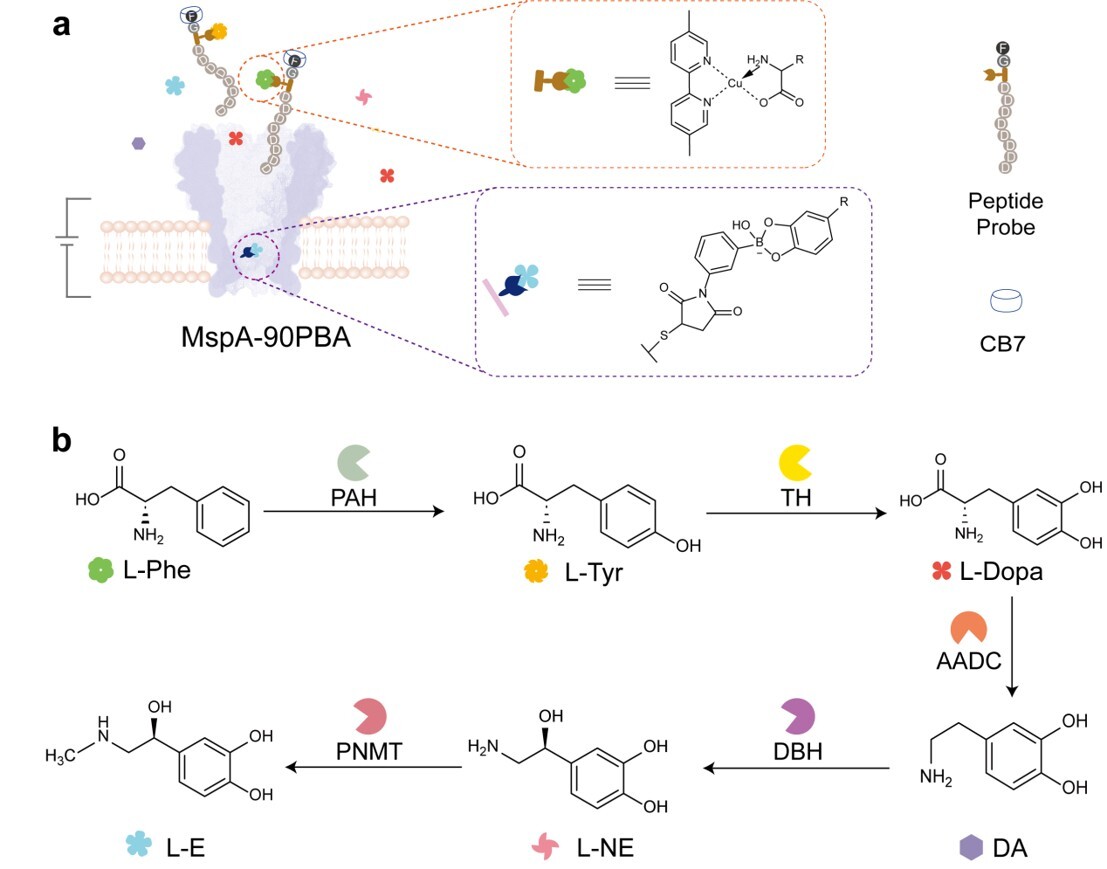
Figure 1. Nanopore sensing strategy for time-resolved monitoring of the catecholamine-related Phe metabolic pathway. (Image by Mingqian Zhang)
This study was published inNature Nanotechnology.
Contact:
Prof. WU Hai-Chen
Institute of Chemistry, Chinese Academy of Sciences
Email: haichenwu@iccas.ac.cn