Electrochemical coupling of CO2 and phosphite for foscarnet synthesis
Foscarnet is an important antiviral drug with significant clinical value. However, its conventional synthetic routes generally involve multiple steps, high costs, and hazardous reagents, making the development of a simple and efficient synthesis highly desirable. Electrosynthesis using CO2 and Na2HPO3 as feedstocks offers a promising approach to overcoming the limitations of traditional routes. Nevertheless, both CO₂ and HPO32− are chemically stable, and the reaction requires coordinated anodic and cathodic processes, making their direct coupling to form a C–P bond particularly challenging.
Buxing Han and Xinchen Kang's team at the Institute of Chemistry of the Chinese Academy of Sciences (ICCAS) has developed a new ionic-liquid-radical-mediated C–P coupling pathway and achieved the electrocatalytic synthesis of foscarnet from CO2 and HPO32− at room temperature.
The study showed that, during electrolysis, Bpy+ cations on the surface of the IL@Bi catalyst are reduced to Bpy• radicals. These radicals subsequently transfer electrons spontaneously to CO2, generating CO2•− radicals and thereby markedly increasing the concentration of CO2•− in solution. The CO2•− radicals then undergo C–P coupling with PO3•2− radicals generated at the anode, enabling efficient electrosynthesis of foscarnet. In this system, a maximum Faradaic efficiency of 37.5% for foscarnet was achieved with a current density of up to 224.2 mA cm−2. This strategy not only provides a new approach for the co-conversion of CO2 and HPO32− under mild conditions, but also offers new insights into the design of other efficient electrocatalytic reaction systems.
The work was recently published in Nature Catalysis (Nat. Catal., 2026, doi:10.1038/s41929-026-01608-6). Ph.D. student Hengan Wang is the first author, and Prof. Xinchen Kang and Prof. Buxing Han are the corresponding authors.
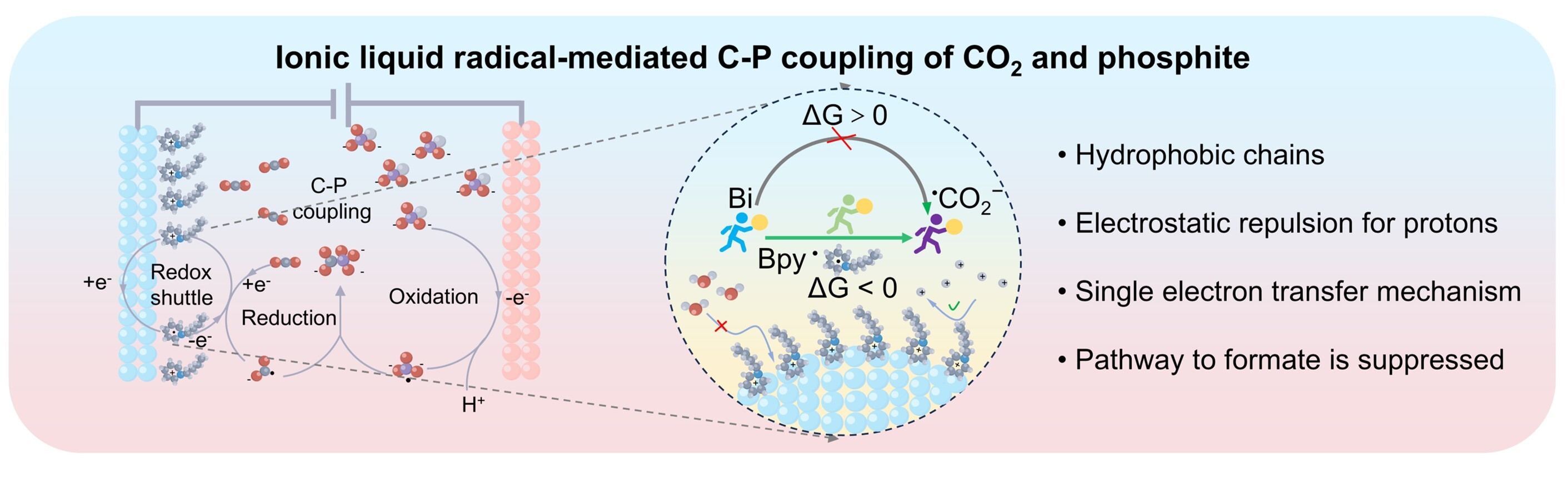
Electrocatalytic coupling of CO2 and HPO32−
(Image by WANG Hengan)
Contact:
Prof. KANG Xinchen
Institute of Chemistry, Chinese Academy of Sciences
Email: kangxinchen@iccas.ac.cn
Keywords: ionic liquid radicals; relayed electron transfer; C–P coupling; foscarnet electrosynthesis