Perovskite–organic tandem solar cells with a photo-transformable stabilizer
Perovskite–organic tandem solar cells (TSCs) have attracted growing interest because of their orthogonal solvent processing, lightweight nature and potential for large-area printing production. Wide-bandgap (WBG) mixed-halide perovskites with high bromide content, which are employed as the front cell material in perovskite–organic TSCs, often suffer from initial halide-mixing inhomogeneity and light-induced halide segregation, limiting the performance of perovskite–organic TSCs. A team led by Dr. MENG Lei and Dr. LI Yongfang at the Institute of Chemistry of the Chinese Academy of Sciences (ICCAS) has now shown how a two-stage strategy can stabilize the mixed-halide phase.
The researchers introduced a photo-transformable additive 4-[3-(trifluoromethyl)-3H-diazirin-3-yl]benzylamine (TDB) into the perovskite precursor. During crystallization, TDB improves the initial halide homogeneity by suppressing the rapid precipitation of the Br-rich phase and accelerating halide mixing upon annealing. During operational illumination, TDB undergoes transformation to form a new species with stronger adsorption on the perovskite grain-boundary surfaces, which inhibits the formation of iodide-related defects, suppresses defect-assisted carrier trapping and ion migration, thereby mitigating light-induced halide segregation. With this combined effect, the representative WBG perovskite (Eg = 1.88 eV) solar cell achieved an open-circuit voltage of 1.42 V. By integrating the WBG perovskite solar cell into a monolithic perovskite–organic TSC, the team achieved a power conversion efficiency (PCE) of 28.80% with a certified steady-state PCE of 28.04%, surpassing all previously reported values for perovskite–organic TSCs.
The photo-transformable nature of TDB enables stage-adaptive functionality, allowing it to sequentially address the challenges arising at two different stages in WBG mixed-halide perovskites. The improved PCE of perovskite–organic TSCs represents an important step toward their practical application. “Our study highlights the critical role of addressing the challenges that arise during crystallization and operational illumination in WBG mixed-halide perovskites, and provides a new pathway for developing high-performance and stable perovskite–organic tandem solar cells,” said Dr. MENG.
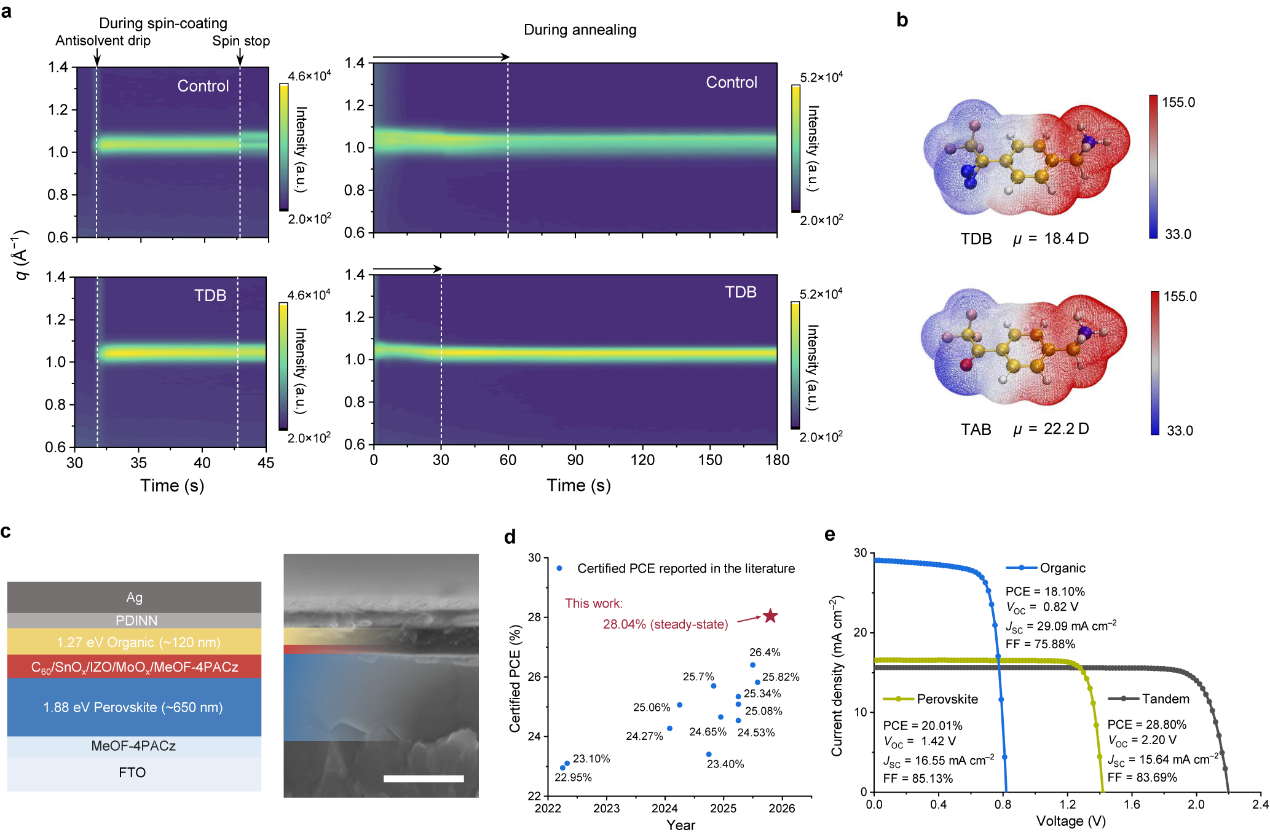
Figure 1. (a) In situ grazing-incidence wide-angle X-ray scattering characterization of the crystallization process of the WBG perovskite. (b) Electrostatic potential maps of the additive molecule TDB and its photoproduct TAB generated under illumination. (c) Device architecture and cross-sectional scanning electron microscopy image of the perovskite–organic TSC. (d) Progress in the PCE of perovskite–organic TSCs. (e) Current density–voltage characteristics of the individual subcells and the perovskite–organic TSC.
Their study was published in Nature on July 13th, 2026 (DOI: 10.1038/s41586-026-10869-x).
(Graphic: ICCAS)