Engineering Dynamic Heterogeneous-homogeneous Hybrid Interfaces for Solar-Driven in Situ Water Remediation
Water pollution in natural aquatic environments often involves a complex mixture of contaminants, ranging from bulk organic pollutants to trace high-risk species such as pathogens and antibiotics. Achieving both broad-spectrum purification and selective removal of these priority contaminants remains a longstanding challenge for in situ water remediation technologies. Although photocatalysis offers a sustainable route for pollutant degradation using solar energy, its practical application is often limited by inefficient reactive oxygen species generation and poor performance in complex natural water matrices.
Recently, the research group led by Prof. Hua Sheng at the Laboratory of Photochemistry, Institute of Chemistry, Chinese Academy of Sciences, reported a new strategy for solar-driven in situ water remediation in Nature Water.
The team developed a dynamic heterogeneous–homogeneous photocatalytic system by constructing a photoresponsive copper anchoring interface on UiO-66-NH2 metal–organic frameworks. Upon light irradiation, anchored Cu2+ ions are reversibly released to form highly reactive copper species that facilitate multi-electron oxygen activation, boosting hydroxyl radical production by nearly two orders of magnitude. Meanwhile, the regenerated copper ions exhibit strong affinity toward high-risk contaminants, including pathogens and antibiotics, enabling simultaneous broad-spectrum pollutant removal and selective elimination of priority pollutants.
To demonstrate practical applicability, the researchers further integrated the catalyst into a floating platform capable of directly utilizing sunlight and atmospheric oxygen. In a 28-day outdoor remediation test using real lake water, the system achieved efficient pollutant removal and disinfection while maintaining excellent operational stability and negligible copper leaching. The platform can also be combined with ecological floating islands, providing a promising approach for sustainable, low-energy, and in situ remediation of open water environments.
This work establishes a dynamic heterogeneous–homogeneous coupling strategy for efficient oxygen activation and offers new opportunities for the development of solar-powered environmental remediation technologies under real-world conditions.
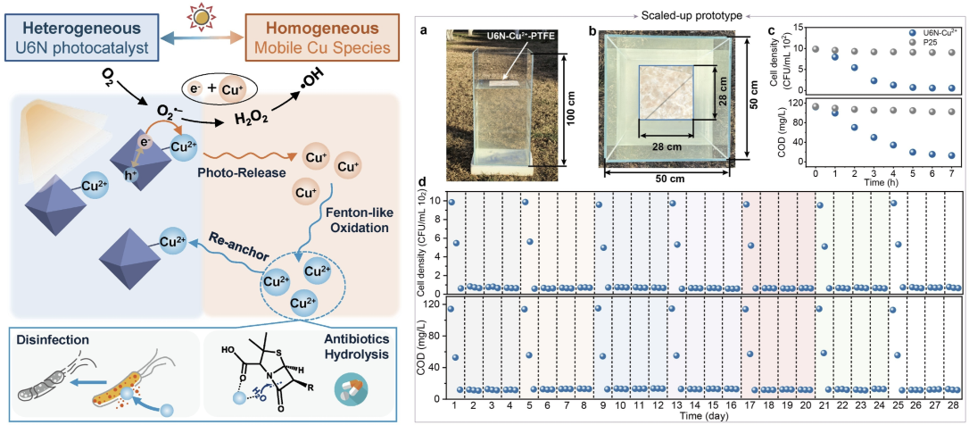
Construction of a heterogeneous photocatalytic-homogeneous Fenton dynamic coupling system and its application in water purification (Image by SHENG Hua)
This study was published in Nature Water.
Contact:
Prof. SHENG Hua
Institute of Chemistry, Chinese Academy of Sciences
Email: hsheng@iccas.ac.cn