Narrow-Bandgap Organic Photovoltaic Catalysts Enable Efficient Solar-Driven Wastewater Remediation
Industrial hydrazine wastewater is generated from diverse sources and poses significant health and ecological risks. Traditional treatments, including Fenton oxidation and electrocatalysis, are often constrained by high energy consumption and/or reliance on additional chemicals. Solar-driven photocatalysis offers a sustainable route for wastewater remediation, but existing photocatalysts still suffer from inefficient use of sunlight and/or photogenerated charge carriers. The development of high-performance photocatalysts offers substantial opportunities to improve solar remediation of wastewater and reduce environmental harm.
To address this challenge, a research team led by Prof. LIN Yuze at the Institute of Chemistry, Chinese Academy of Sciences (ICCAS), induce narrow-bandgap heterojunction organic photovoltaic catalysts (OPCs) and develop Al2O3-coated nanoparticles (OPC@Al2O3), for efficient and stable solar-driven hydrazine wastewater remediation. The study entitled “Solar remediation of hydrazine wastewater using efficient narrow-bandgap organic photovoltaic catalysts” was published in Nature Water.
The OPC@Al2O3 system possesses the advantages of broad-spectrum sunlight harvesting, efficient photogenerated charge utilization, stable operation in complex aqueous matrices, and facile catalyst recovery and reuse. Based on the proton-coupled electron transfer mechanism, efficient, stable, and sustainable remediation of hydrazine wastewater has been driven by solar light, generating hydrogen with industrial/energy added value, while producing no toxic byproducts. Under simulated sunlight (AM 1.5 G, 100 mW cm−2), the hydrazine concentration in 640 ppm wastewater was reduced to trace levels (0.038 ± 0.01 ppm) within 5 hours, achieving a wastewater treatment efficiency that is more than two orders of magnitude higher than that of previous solar photolysis. The treated wastewater meets industrial and agricultural safety standards and exhibits markedly improved biosafety compared with Fenton oxidation treatment. This study presents a feasible, efficient, and scalable approach to converting hazardous wastewater into valuable products, thereby advancing the transition toward greater sustainability.
This work was financially supported by the CAS Project for Young Scientists in Basic Research, the Strategic Priority Research Program of the CAS, and the National Natural Science Foundation of China.、
This study was published in Nature Water.
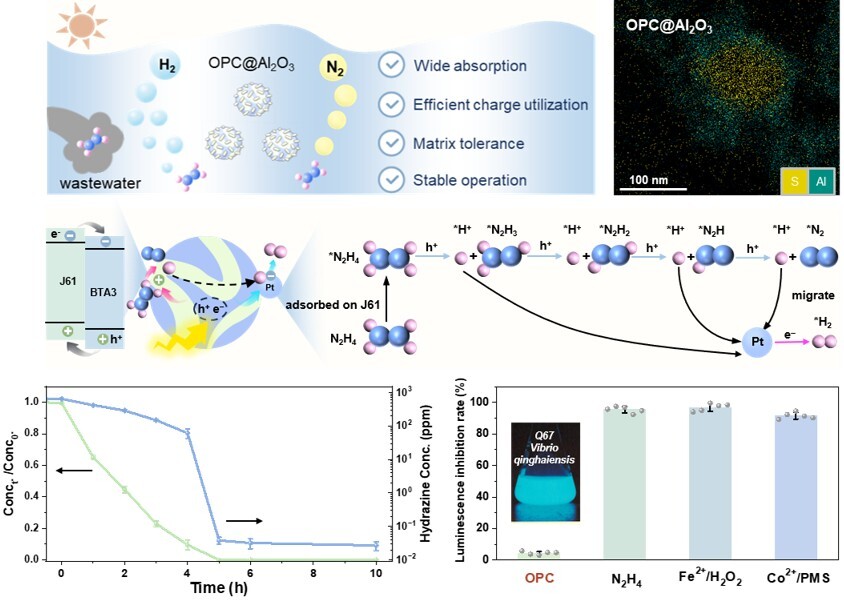
Efficient solar remediation of hydrazine wastewater using narrow-bandgap OPCs. (Image by Prof. LIN Yuze)
Contact:
Prof. LIN Yuze
Institute of Chemistry, Chinese Academy of Sciences
Beijing 100190, China
Email: linyz@iccas.ac.cn
Keywords: hydrazine wastewater remediation; organic photovoltaic catalysts; donor–acceptor heterojunctions; hydrogen production; proton-coupled electron transfer.