Researchers Achieve Important Progress in Selenium Solar Cell
Elemental selenium, as one of the oldest photovoltaic materials, has recently regained widespread attention in tandem and indoor photovoltaics due to its intrinsically wide bandgap of approximately 1.9 eV. In addition, selenium exhibits remarkable advantages such as high absorption coefficient, excellent stability, environmental benignity, and low cost, making it a highly promising wide-bandgap photovoltaic absorber. However, during the conventional thermal annealing process for preparing selenium thin films, severe dewetting tends to occur, forcing a significant reduction in annealing time and resulting in poor crystalline quality. This issue limits the grain size of the resulting films to about 500 nm, leading to substantial non-radiative recombination losses, which greatly hinder further improvements in device open-circuit voltage and efficiency. Therefore, achieving controllable fabrication of dense, continuous, and large-grain selenium thin films is of great significance for enhancing the performance of selenium solar cells.
Supported by the National Natural Science Foundation of China, the Ministry of Science and Technology, and the Chinese Academy of Sciences, the team of WAN Lijun and XUE Dingjiang from Institute of Chemistry, has long been dedicated to research on selenium solar cells and has achieved a series of important progresses (Sci. Adv. 2022, 8, eadc9923; Joule 2024, 8, 1430; J. Am. Chem. Soc. 2024, 146, 6345; Angew. Chem. Int. Ed.2025,64, e202413429; Angew. Chem. Int. Ed. 2025, 64, e202505297; Adv. Mater. 2025, 37, 2410835).
Recently, building on previous work, the research team proposed a "illumination-assisted annealing (IAA)" strategy to address the key challenge of dewetting during thermal annealing of selenium thin films. The researchers first exploited the photo-induced crystallization of selenium at room temperature to convert amorphous selenium films into a crystalline state without triggering dewetting, followed by further thermal annealing to enhance the crystalline quality. The core of this strategy lies in: the room-temperature photo-induced crystallization stage bypasses the thermodynamic energy barrier through photo-excitation, enabling a dewetting-free crystallization process; subsequent high-temperature annealing promotes further grain growth, forming dense, continuous, and pinhole-free large-grain films. This synergistic process effectively suppresses non-radiative recombination centers and leakage pathways, reducing the defect state density to 6.9×1014 cm-3 and extending the carrier lifetime to 22.9 ns. The resulting selenium solar cells achieved a certified efficiency of 10.3% with an open-circuit voltage as high as 1.03 V, and the unencapsulated devices exhibited no performance degradation after 1000 hours of maximum power point tracking under ambient conditions. This work deepens the understanding of the crystallization kinetics of inorganic thin films and the mechanisms for modulating non-radiative recombination, providing new insights for the preparation of high-performance inorganic thin-film photovoltaic materials.
The related findings were published in Nat. Energy, 2026, 11, 274. The first author of the paper is Ph.D. student WEN Xin, and the corresponding authors are Professor XUE Dingjiang, Professor WAN Lijun, and Professor HOU Yi from the National University of Singapore. In the same issue, the News & Views section of Nature Energy featured a commentary titled "Selenium hits double digits," highlighting that "this efficiency breakthrough is significant; selenium cells have successfully crossed the 10% efficiency threshold, further confirming the great application potential of elemental selenium in the photovoltaic field."
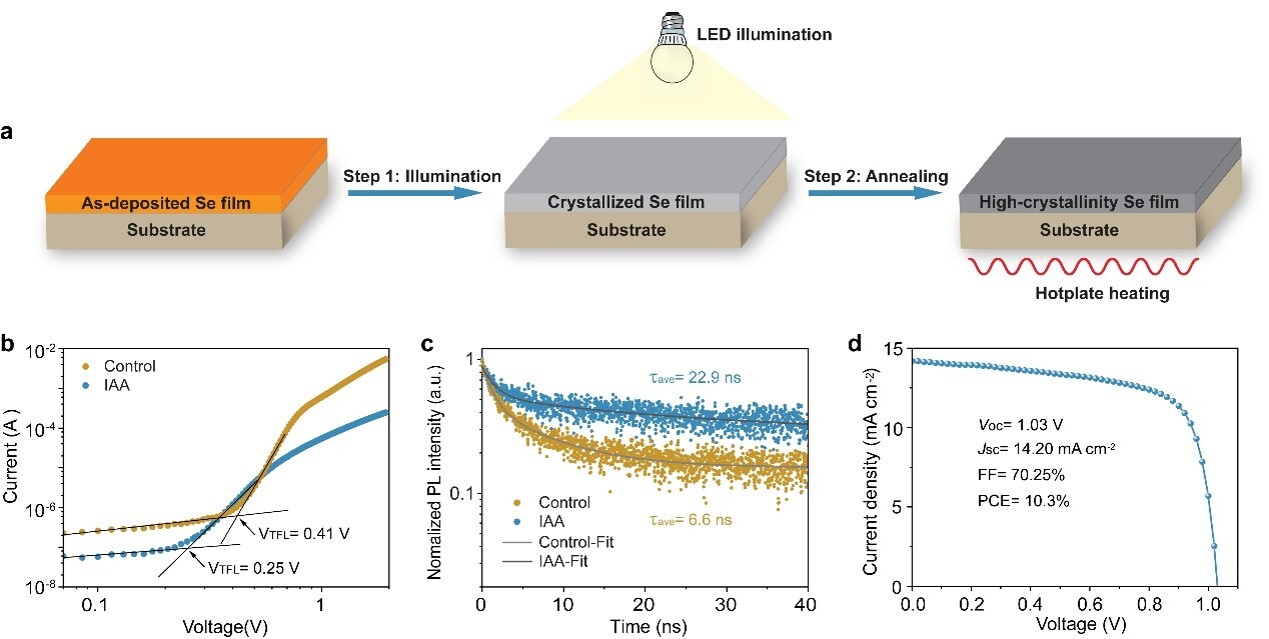
Figure. (a) Schematic illustration of the light-assisted annealing (IAA) strategy; (b) Space-charge-limited current (SCLC) curves of control and IAA devices; (c) Time-resolved photoluminescence (TRPL) spectra of control and IAA selenium films; (d) Certified current density–voltage (J–V) curve of the selenium solar cell. (Image by WEN Xin)
Contact:
Prof. XUE Dingjiang, Prof. WAN Lijun
Institute of Chemistry, Chinese Academy of Sciences
Email: djxue@iccas.ac.cn, wanlijun@iccas.ac.cn