Asymmetric Halogen Engineering Enables High-Efficiency Perovskite–Organic Tandem Solar Cells
Perovskite-organic tandem solar cells (TSCs) represent a promising route to surpass the Shockley-Queisser efficiency limit of single-junction solar cells by harvesting complementary broad-spectrum light. However, the development of perovskite-organic TSCs has been impeded by the scarcity of efficient narrow-bandgap small-molecule acceptors in organic solar cells. As the bandgap narrows, the energy gap law dictates a sharp rise in non-radiative decay, causing severe non-radiative energy loss that limits open-circuit voltage and overall device efficiency.
In a study published in Nature Photonics (https://doi.org/10.1038/s41566-026-01906-2), a joint research group led by Prof. LI Xiaojun and Prof. LI Yongfang from the Institute of Chemistry, Chinese Academy of Sciences (ICCAS), alongside Prof. HOU Yi from the National University of Singapore (NUS), proposed an asymmetric halogen heavy-atom modification strategy to overcome these non-radiative energy loss challenges. By replacing the fluorine substituents on a single side of the symmetric acceptor BTA-E3 with heavier halogens like chlorine, they synthesized a series of novel narrow-bandgap acceptors, most notably E3-2Cl.
The heavy-atom effect effectively restricts high-frequency molecular backbone vibrations and suppresses electron-phonon coupling. This fundamentally mitigates exciton thermalization losses, enhances luminescence efficiency, and reduces non-radiative energy loss. Simultaneously, this asymmetric approach strengthens terminal-mediated intermolecular interactions, resulting in a well-defined donor-acceptor double fibril morphology with improved phase separation in the blend films.
Consequently, single-junction organic solar cells based on E3-2Cl delivered a remarkably low energy loss of 0.488 eV and a power conversion efficiency (PCE) of 20.7%. Furthermore, by integrating this optimized organic rear cell with a wide-bandgap perovskite front cell, the researchers fabricated a monolithic perovskite-organic TSC with an aperture area exceeding 1 cm2. This large-area tandem device achieved an impressive PCE of 28.2% (certified at 27.5%).
“Our work establishes a clear and viable molecular design strategy for realizing efficient narrow-bandgap acceptors with suppressed energy loss. Such materials, along with their associated molecular engineering framework, are highly favorable for realizing highly efficient perovskite-organic TSCs.” said Prof. LI Xiaojun.
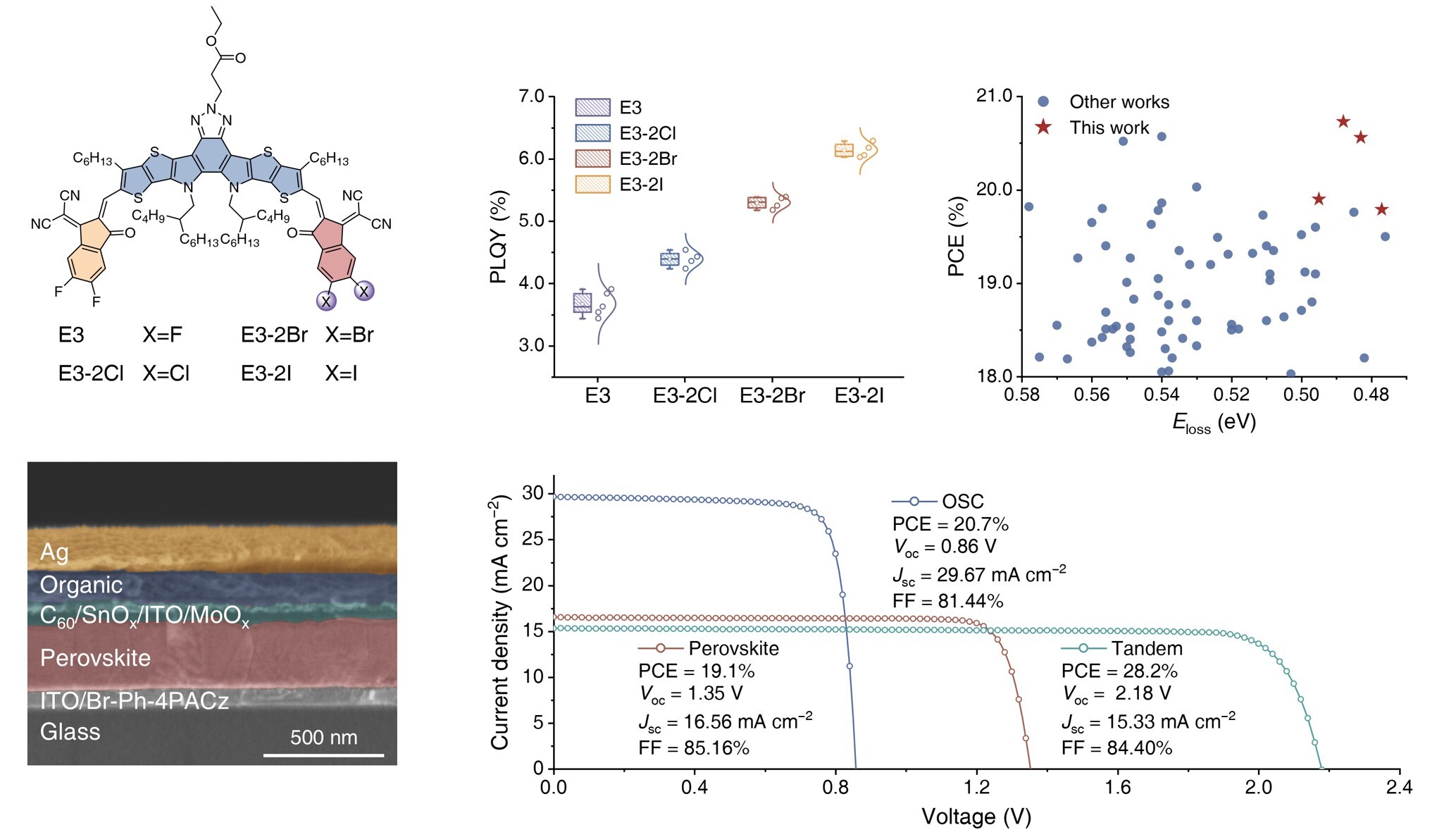
Narrow-bandgap acceptors with suppressed exciton thermalization losses of for high-performance perovskite-organic tandem solar cells. (Image by HE Haozhe)
Contact:
Prof. LI Xiaojun or Prof. LI Yongfang
Institute of Chemistry, Chinese Academy of Sciences
Email:lixiaojun@iccas.ac.cn, liyf@iccas.ac.cn