Irregular hierarchical-porous polymer for high-performance soft thermoelectrics
Conjugated polymers are promising candidates for lightweight, low-cost thermoelectric generators (TEGs) in wearable electronics due to their low Young’s modulus and excellent solution processability. However, their thermoelectric performance has historically remained inferior to flexible inorganic materials. Furthermore, the scarcity of scalable fabrication routes has limited their application in thermoelectric power generation and solid-state cooling.
Prof. DI Chong-an and colleagues from the Institute of Chemistry, Chinese Academy of Sciences developed irregular hierarchical‑pore thermoelectric polymer (IHP-TEP) films via fine‑tuned critical-transition phase separation, which achieved a dimensionless figure of merit (zT) of 1.64.
The "phonon-glass electron-crystal" model represents the ideal thermoelectric structure. While porous structures are typically used to regulate phonon transport and reduce thermal conductivity, they often simultaneously impede charge transport. Despite improvements in the zT values of porous materials, effective strategies to concurrently induce phonon scattering and enhance carrier transport in polymers have remained elusive for decades.
To address this, the researchers engineered an IHP-TEP featuring multiscale pores and "throats"—from sub‑10 nm to micrometers—to create diverse phonon-scattering pathways. These include boundary scattering, size effects, and phonon–phonon interactions, which collectively minimize lattice thermal conductivity. Simultaneously, the nanoconfinement effect during phase separation promotes molecular crystallization, increasing carrier mobility and electrical conductivity. This dual-control mechanism forms the foundation of the IHP-TEP’s high performance.
Optimized 70/30 blend films of selenium‑substituted diketopyrrolopyrrole (PDPPSe‑12) with polystyrene produces an interconnected pore network ranging from 5.9 nm to 1.8 μm (porosity of 0.23±0.01). These are connected by narrow throats (5 nm–1.3 μm) packed with fiber-like domains exhibiting strong molecular orientation. These IHP-TEP films produced a minimum total thermal conductivity of 0.16 W m⁻¹ K⁻¹ and the carrier mobility increased by up to 52%, yielding a maximum power factor of 772 μW m⁻1 K⁻2 and a peak zT of 1.64 at 343 K. The architecture is compatible with scalable spray-coating method, enabling large-area, lightweight, and solution-processable thermoelectric generators with normalized power density up to 1.28 µW cm⁻² K⁻², highlighting their potential as flexible power sources.
This architecture promotes intricate heat-scattering pathways while boosting charge mobility, enabling unprecedented zT performance in soft thermoelectrics. As a broadly applicable design strategy, it offers a scalable and sustainable route to high-efficiency, flexible power sources, paving the way for advanced wearable and portable energy-harvesting technologies.
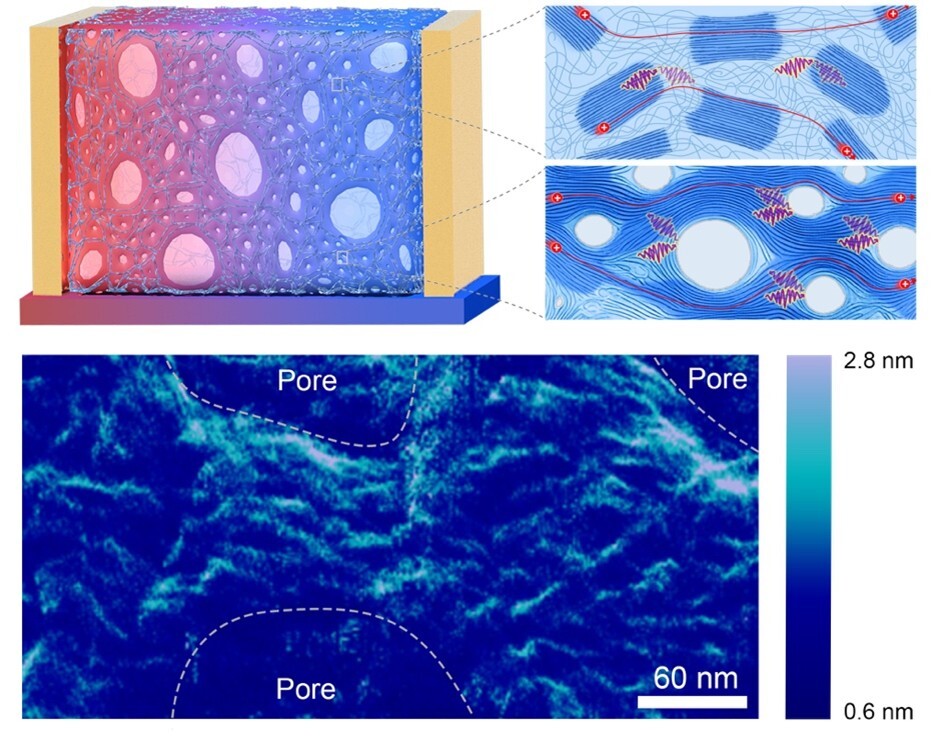
Design concept and characterization result of IHP-TEP structure (Image by ZHANG Xiao)
Their study, titled "Irregular hierarchical-porous polymer for high-performance soft thermoelectrics" was published in Science (DOI: 10.1126/science.adx9237).
Keywords: organic thermoelectrics materials, irregular hierarchical-porous polymer
Contact:
Prof. Chong-an Di
Chinese Academy of Sciences
Email: dicha@iccas.ac.cn (C.-a.D.)