Researchers Develop Novel Organic Transistors for Self‑Color‑Correcting Vision
Visual perception devices represent a critical direction in fields such as humanoid robots, autonomous driving and artificial retinas. However, conventional photodetectors often face issues like overexposure and color cast under complex lighting conditions, which hinder precise imaging and rapid identification in dynamic and complicated environments—posing a significant challenge in striking machine vision. Achieving adaptive feedforward perception and in-sensor information processing at the device level represent a key step for advancing next-generation visual perception systems.
Prof. Daoben Zhu and Chong-an Di at the Institute of Chemistry, Chinese Academy of Sciences, in collaboration with Prof. Xiaowei Zhan's team from Peking University, have proposed and constructed a panchromatic organic active adaptation transistor (P-OAAT) with wide-color-gamut autonomous color-correction capabilities. This advancement offers a new perspective for the development of novel visual intelligent perception system.
This excellent property was achieved by incorporating two bulk heterojunctions into an organic transistor. The broadband absorption and efficient photocarrier generation of the heterojunctions allow the device to achieve an active adaptation index (AAI) exceeding 150 across the visible spectrum, effectively mimicking the adaptive behavior of human photoreceptors. They also proposed a novel built-in color correction architecture by incorporating three sub-pixels for red, green, and blue stimuli, following the human visual adaptation principle (von Kries coefficient law). The integrated devices maintain stable color perception even under biased lighting conditions. To demonstrate practical scalability, a large-scale integration of over one million pixels was fabricated on a 4-inch wafer, achieving a resolution of 347 ppi. With an advanced imaging test and simulated with an artificial neural network (ANN), the system achieved autonomous color-visual correction that outperformed state-of-the-art cameras, boosting recognition accuracy to 96.3% even under distorted illumination. The results demonstrate their promising applications in color calibration and intelligent visual sensing, which paves a new pathway for the next-generation intelligent visual perception technology.
This work was published in Nature Photonics (DOI: 10.1038/s41566-025-01812-z) on Jan. 7, 2026, entitled “In-Pixel Color Correction with Organic Self-Adaptive Transistors”.
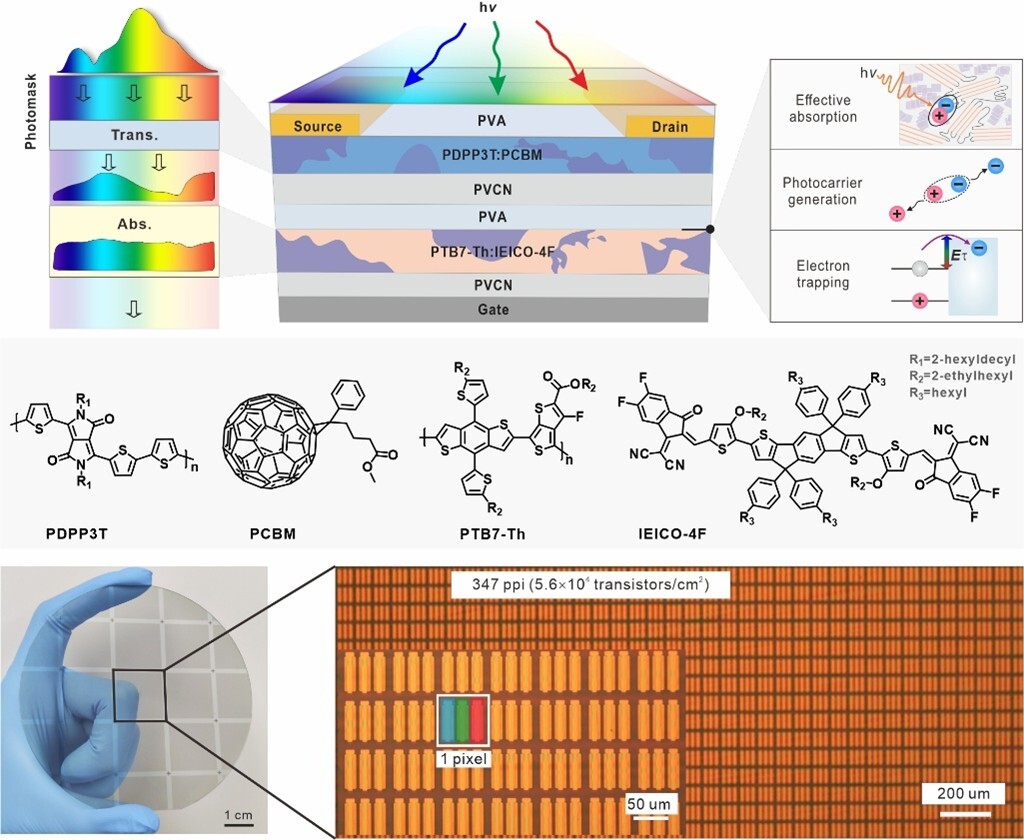
Device structure of the P-OAAT and the integrated device array.
Contact:
Prof. DI Chongan
Institute of Chemistry, Chinese Academy of Sciences
Email: dicha@iccas.ac.cn